Korean Football Players Tier List Maker — Rank the Greatest Taegeuk Warriors

Best Korean Football Players Tier List Maker is a free interactive tier list maker on Tier List Maker. Drag and drop 19 images across 5 ranking tiers (S, A, B, C, D), customize everything, then download or share your ranking — no login and no watermark.
Features of this tier list maker:
- Drag & drop ranking — Drag any image from the pool into a tier and drag between tiers to re-rank; the × on an image inside a tier sends it back to the pool.
- Download Tier List — Save the finished tier list as a PNG image that matches the on-screen design exactly — free, no watermark.
- Share Tier List — Publish the ranking to its own share page with a link, emoji reactions, social buttons and comments.
- ✨ AI Generate from AI — Paste a tier list generated with ChatGPT or any AI assistant and it is built instantly, items pre-placed in their tiers.
- Embed — Copy an iframe snippet and embed the interactive tier list in any website or blog.
- Add images — Upload your own images from your device and rank them alongside the template images.
- Add text — design studio — Create text cards or draw custom items with pen, spray, shapes, emoji stamps, fill bucket, styled text and uploaded images; every object can be moved, resized and rotated.
- Add Tier & tier editing — Add, rename, recolor, reorder or delete tiers to build any ranking scale.
- Reset — Send every image back to the pool and start the ranking over.
- ⛔ Report — Send the site owner a suggestion for new images or changes to this template.
- Fullscreen — Pin the tool to the whole window for distraction-free ranking.
Tiers: S, A, B, C, D
The 19 images in this template: imageye___-_zzzzz-1693599389lee-woon-jae, imageye___-_zzzzz-1693599389jo-hyeon-woo, imageye___-_cha-bum-kun, imageye___-_hwang-ui-jo, imageye___-_zzzzz-1693599389yoo-sang-chul, imageye___-_zzzzz-1693599388cha-bum-kun, imageye___-_kim-young-gwon, imageye___-_hong-myong-bo-, imageye___-_son-golden-boot, imageye___-_park-chu-young, imageye___-_lee-young-pyo, imageye___-_ahn-jung-hwan, imageye___-_zzzzz-1693599388hwang-sun-hong, imageye___-_zzzzz-1693599389seol-ki-hyeon, imageye___-_cha-du-ri, imageye___-_zzzzz-1693599389ki-seung-yeung, imageye___-_kim-shin-wook, imageye___-_park-ji-sung, imageye___-_thechoprivate
Korea has given the world some of football’s most compelling stories. From Cha Bum-kun terrorising Bundesliga defences in the late ’70s and ’80s, to Park Ji-sung winning a Champions League at Old Trafford, to Son Heung-min sharing the Premier League Golden Boot with Mo Salah — and now Son leading the line at the 2026 World Cup for what may be his final dance on the biggest stage. The debate over who belongs where has never been more active.
Whether you’re ranking the all-time legends, the current national team stars, or both — opinions are strong, and the arguments are real. Who is the greatest Korean footballer ever? Is Son already in a class of his own above Park Ji-sung? Where does Kim Min-jae’s rise fit in the conversation? What about Lee Kang-in, still only 23 at the 2026 World Cup and already a PSG starter?
The Korean football players tier list maker below has everyone already loaded in — current stars, rising names, and all-time legends. No uploads, no sign-up, no fuss. Drag your picks into position and settle it once and for all.
How to Use the Korean Football Players Tier List Maker
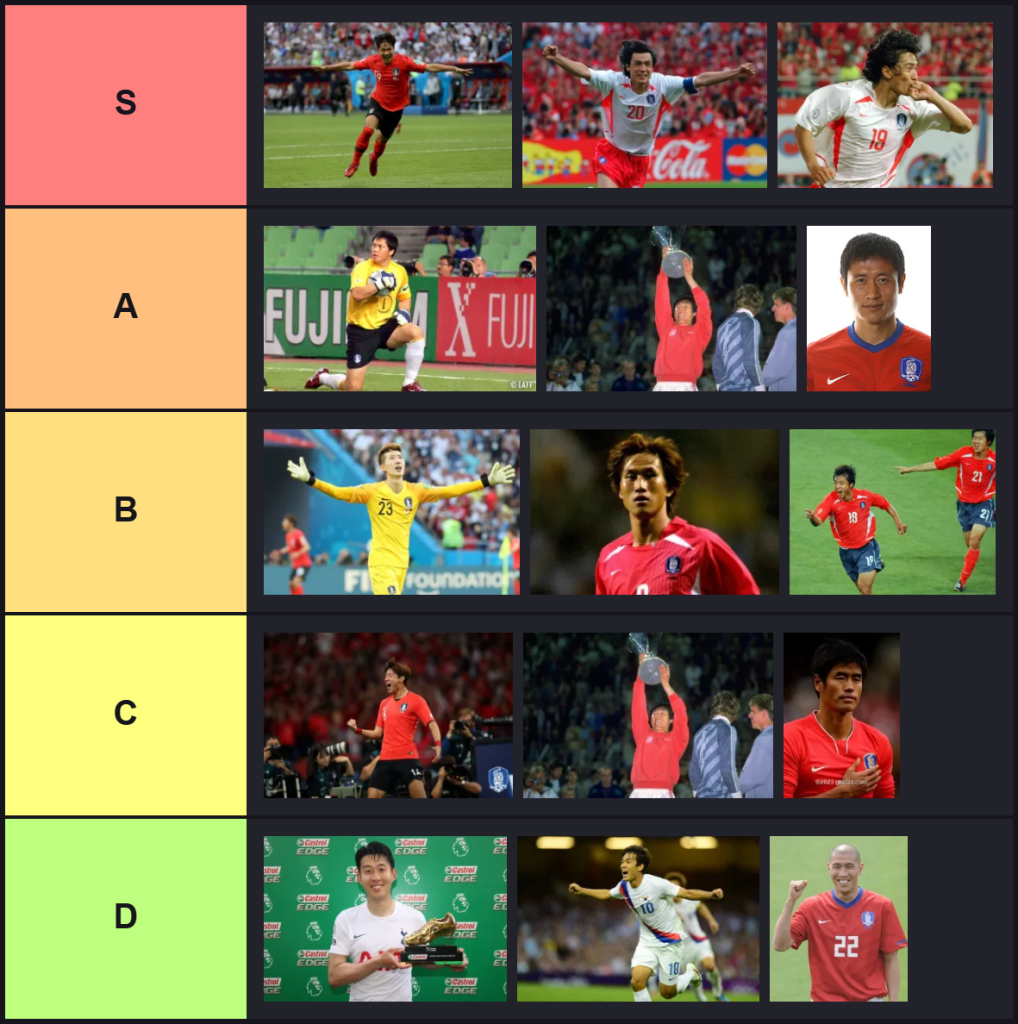
- Drag each player into the tier they belong — S (all-time elite), A (world class), B (quality international), C (solid contributor), or D (overrated/overhyped).
- Rearrange within tiers to get your exact order locked in.
- Hit Download to save your tier list as a PNG and share the debate.
Simple as that. Your Korean football rankings, ready to post.
How to Rank Korean Football Players: The Criteria
Good tier lists aren’t just vibes — they’re arguments. Here’s the framework for ranking Korean players fairly across different eras:
| Criteria | Weight | What to Look For |
|---|---|---|
| Peak Performance Level | 30% | How high did they go? Club football level, international competition quality, big-game performances |
| Longevity & Consistency | 25% | Did they sustain elite output over years, or was it a short peak? |
| International Impact | 20% | Caps, goals, World Cup moments, Asian Cup performances, leadership for the national team |
| Club Trophy Haul | 15% | League titles, European trophies, domestic honours — what they actually won |
| Legacy & Influence | 10% | Did they open doors, set records, or change how the world saw Korean football? |
Total: 100%
Cross-era comparisons are always messy, but these criteria at least give you a consistent frame — whether you’re debating Park Ji-sung vs Son Heung-min or arguing Cha Bum-kun’s place in the all-time conversation.
Korean Players Worth Debating Most
The All-Time Contenders (Your S-Tier Argument Starters)
Son Heung-min — The current benchmark for Korean football, full stop. Over a decade at Tottenham Hotspur, Son scored 173 goals across all competitions and became the first Asian player to win the Premier League Golden Boot in 2021–22, sharing the honour with Mo Salah on 23 goals. Since moving to LAFC in August 2025, he hit 12 goals and 4 assists in just 13 games (including playoffs), with a goal contribution every 68.9 minutes — the second-best rate in MLS behind only Lionel Messi that season. He also won the 2025 MLS Goal of the Year for a stunning free kick against FC Dallas. At the 2026 World Cup, Son is captain, set-piece taker, and the focal point of South Korea’s attack — and enters the tournament with 54 international goals from 141+ caps. The debate isn’t whether he’s Korea’s greatest. It’s whether he’s the greatest Asian player ever.
Cha Bum-kun — The trailblazer. Long before any Korean player was a household name in Europe, “Cha Boom” was rattling nets in the Bundesliga with Eintracht Frankfurt and Bayer Leverkusen. He won the UEFA Cup twice — once with Frankfurt in 1980 and once with Leverkusen in 1988, scoring a dramatic equaliser in that final against Espanyol. Sir Alex Ferguson publicly called him “unstoppable.” He retired with 136 caps and 58 international goals, both South Korean records at the time, having received just one yellow card across his entire career. A genuine trailblazer for Asian football in Europe.
Park Ji-sung — The most decorated Korean club player ever. His seven seasons at Manchester United under Sir Alex Ferguson brought four Premier League titles, three League Cups, and the 2008 Champions League — making him the first Asian player to lift the European Cup. He also scored in three consecutive World Cups (2002, 2006, 2010), the first Asian player to do so. His famous 2002 goal against Portugal sent Korea into the knockout stages on home soil. Arguably the greatest big-game performer Korean football has produced.
World Class Right Now (Strong A-Tier Cases)
Kim Min-jae — The best Korean defender of the modern era and arguably the best centre-back currently playing in the Bundesliga. After an iconic season at Napoli that helped them end a 33-year wait for the Serie A title, Kim moved to Bayern Munich where he has been a consistent starter. At the 2026 World Cup, he anchors South Korea’s back three under Hong Myung-bo’s system. The kind of defender who makes opposing No. 9s question their career choices.
Lee Kang-in — Still just 23 during the 2026 World Cup, Lee Kang-in has already been named the Best International Asian Player of 2025. A Paris Saint-Germain starter pulling strings in Ligue 1, his technical quality and creativity mark him as a generational Korean talent who could have years of elite club football still ahead of him. His partnership with Son Heung-min for the national team is one of the most exciting attacking combinations in Asian football right now.
Hong Myung-bo — As a player, arguably the most important defender in Korean football history. The first Asian player to appear in four consecutive World Cups and the first Asian to win the Bronze Ball at a FIFA World Cup (2002). He is now back in the picture as South Korea’s current head coach heading into the 2026 tournament — meaning his legacy spans both sides of the dugout.
Rising Stars and Ones to Watch
Hwang Hee-chan — Pacy, relentless, and dangerous in behind, the Wolverhampton Wanderers forward has been South Korea’s reliable secondary striker for several years. Frequently a match-winner off the bench or from the left channel, he’s the kind of player who punishes you for looking at Son for too long.
Hwang In-beom — The engine of the current South Korean midfield. Playing for Feyenoord in the Eredivisie, Hwang In-beom controls tempo, breaks up play, and contributes at both ends. He was the standout-rated performer for Korea in recent league play with an 8.89 FotMob rating, and his role at the 2026 World Cup as the midfield anchor is critical.
Lee Jae-sung — The Mainz midfielder brings intelligence, work rate, and an ability to play multiple roles across the attacking and central zones. Consistent performer for club and country, and one of the understated reasons Korea’s midfield functions as well as it does.
The Legacy Names (How Do You Rate Them Now?)
Hong Myung-bo (Player Era), Hwang Sun-hong, Lee Young-pyo, Ki Sung-yueng, Seol Ki-hyeon — All household names for Korean football fans of a certain era. The 2002 World Cup generation in particular carries enormous emotional weight, having led South Korea to a semi-final on home soil — still the greatest achievement in the nation’s footballing history. Where you rank them relative to the modern crop is where tier list arguments really kick off.
Common Tier List Mistakes (And How to Fix Them)
| Mistake | The Fix |
|---|---|
| Putting Son in A-tier because he left the Premier League | LAFC was a strategic move, not a step down — 12 goals in 13 games and MLS Goal of the Year proves he’s still elite. He stays S. |
| Ignoring Cha Bum-kun because he played before your time | Two UEFA Cup wins and an “unstoppable” verdict from Sir Alex Ferguson don’t get cancelled by your birth year. |
| Ranking Park Ji-sung below Son automatically | Son is probably the better player. But Park’s trophy cabinet — four PL titles, a Champions League — is a legitimate S-tier argument. This one earns a real debate. |
| Sleeping on Kim Min-jae | He’s not a trendy pick because defenders rarely are. But a Serie A title winner and Bundesliga regular at the top level? A-tier at minimum. |
| Underrating the 2002 generation | Hong Myung-bo’s Bronze Ball was earned at football’s biggest tournament, not a made-up metric. The context matters when you’re ranking across eras. |
Share Your Korean Football Player Rankings
Save your tier list as a PNG and take it straight to:
- Twitter / X — Post it in any South Korea 2026 World Cup thread. Korean football Twitter is active and opinionated.
- Instagram — Stories format is perfect for PNG tier lists; tag other Korean football fans for response lists.
- Football Discord servers — Drop it into any Asian football or K-League channel and watch the chaos start.
Suggested hashtags: #KoreanFootball #TaegeukWarriors #SonHeungmin #WorldCup2026 #KoreanFootballTierList #KLeague #FIFA2026
Tag @TierListMaker in your post — we reshare the best tier lists every week.
Want more football ranking content? Check out the full Football Players Tier List for global comparisons, browse the complete Sports Tier Lists hub, or head over to the Women’s Football Clubs Tier List to keep the debates going.
FAQ: Korean Football Players Tier List
How do I make a Korean football players tier list? Use the free tier list maker embedded on this page — all the major Korean football players are pre-loaded as images. Drag each player into the tier that fits (S through D), rearrange until your ranking feels right, then download your finished list as a PNG. No account, no uploads, no setup required.
Who is the greatest Korean footballer of all time? Son Heung-min is the consensus pick for most fans — his Premier League Golden Boot (2021–22), 173 goals for Tottenham, and continued excellence at LAFC and for the national team make the argument compelling. But Cha Bum-kun’s two UEFA Cup wins and Park Ji-sung’s Champions League with Manchester United mean the top of the all-time list is a genuine three-way debate.
Is Son Heung-min still world class after moving to MLS? Yes. Son scored 12 goals and added 4 assists in just 13 LAFC games in 2025, with a goal contribution rate behind only Messi in MLS that season. He also won the 2025 MLS Goal of the Year. At the 2026 World Cup, he’s still South Korea’s captain, first-choice striker, and set-piece specialist. The MLS move doesn’t diminish the player.
What records does Park Ji-sung hold? Park Ji-sung became the first Asian player to win the UEFA Champions League (2008 with Manchester United) and the first Asian player to score in three consecutive World Cups (2002, 2006, 2010). He won four Premier League titles and three League Cups at Old Trafford, making him the most decorated Asian club footballer in history.
Who are the best young Korean footballers right now? Lee Kang-in is the standout name — the PSG midfielder was named Best International Asian Player of 2025 and is still only 23 during the 2026 World Cup. Hwang In-beom (Feyenoord) is another one to watch, with his midfield performances earning some of the highest ratings of any Korean player in recent seasons.
What was South Korea’s best-ever World Cup finish? South Korea reached the semi-finals of the 2002 FIFA World Cup, which they co-hosted with Japan — the best result ever achieved by an Asian nation at a World Cup. The squad included Hong Myung-bo (who won the Bronze Ball), Park Ji-sung, and Cha Du-ri. It remains the defining moment in Korean football history.
Article last updated: June 2026. Player data sourced from Wikipedia – South Korea national football team and FIFA.com.
Ready to settle it? Jump back to the tool and build your Korean football players tier list now.
![Nascar_Tier_List[1]](https://tier-list-maker.com/wp-content/uploads/2025/02/Nascar_Tier_List1.webp "Nascar Tier List | The best Nascar Tier List 2025 5")
![Apex_Ledgen_Tier_List[1]](https://tier-list-maker.com/wp-content/uploads/2025/02/Apex_Ledgen_Tier_List1.webp "Apex Legends Tier List | The best Apex Ledgen Tier List 2025 6")
![Doritos_Tier_List_Maker[1]](https://tier-list-maker.com/wp-content/uploads/2025/02/Doritos_Tier_List_Maker1.webp "Doritos Tier List Maker | the best Doritos Tier List 2026 7")
![JJK_Tier_List[1]](https://tier-list-maker.com/wp-content/uploads/2025/02/JJK_Tier_List1-768x410.webp "JJk Characters Tier List | the best JJK Tier List 2026 9")